Map of Portion of Miami University Campus where the Meeting will be held.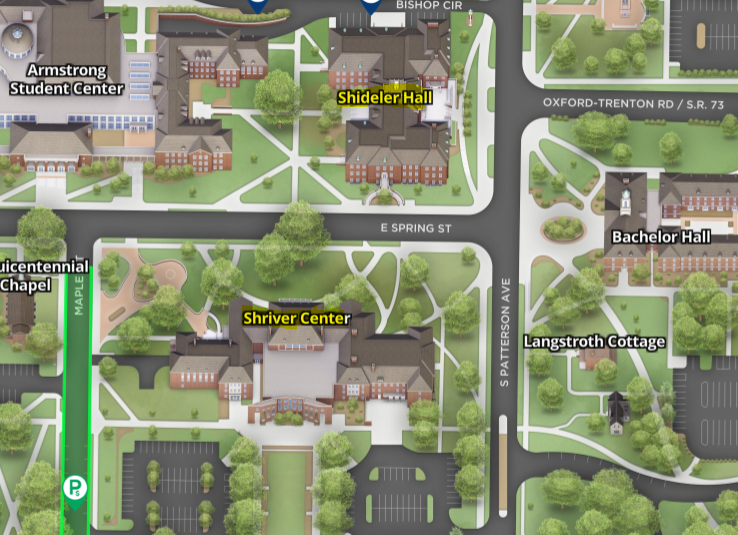
Shideler Hall (Sunday) and Shriver Center (Monday-Tuesday) highlighted in Yellow. Metered parking shown in Green.
Interactive Map can be found here
Pre-Conference Workshop: Cloud Foundations in the EarthScope GeoLab with Applications for Earthquake Template Matching | 1:00 - 4:00 pm | 051 Shideler Hall
For participants: Visit courses.earthscope.org, Click Enrollment hub on the landing page, Log in with an EarthScope account (or create one for free), Choose Cloud Foundations to enroll.
Icebreaker Reception | 6:00 - 8:00 pm | Foyer of Shideler Hall
Oral Session 1: Central & Eastern U.S. Sources & Structure | Monday 8:30 am - 9:30 am
S1-1: Ebel, J.E., A First Look at Data from the Nodal Array Recordings of the 2024 New Jersey Earthquake Aftershocks.
S1-2: J. Gong (Indiana U), G. Pavlis (Indiana U), D. Acharya (Indiana U), M. Islam (Indiana U), P. Dewaelsche (Indiana U), M. Miller (Indiana U), P. Chiang (Indiana U), T. Lee (National Taiwan U), N. Perdomo (Indiana U), E. Sherrill (Indiana U), K. Johnson (Indiana U), M. Hamburger (Indiana U), T. Stigall (Indiana U), Glenn Bear (alumni Indiana U) , A Possible Crustal-Scale Blind Fault Beneath the Wabash Valley Imaged by Receiver Functions from a Nodal Seismic Array .
S1-3: T. A. Norris (Ohio Geological Survey), The Role of HVSR Geophysics in Remapping Ohio’s Subsurface and Rediscovering the Teays River Valley.
S1-4: E. Beauce (Columbia University), F. Waldhauser (Columbia University), W.-Y. Kim (Columbia University), D. Schaff (Columbia University), K. Wang (Chinese Academy of Sciences), W. Zhu (UC Berkeley), 16 Years of Microseismicity in Eastern North America Provide Insights Into the Earthquake Driving Mechanisms and Nucleation Properties in the Slowly Deforming Region.
Poster Session | Monday 9:30 am - 11:00 am
Oral Session 2: Induced Seismicity | Monday 11 am - Noon
S2-1: N. Ushakov (University of Texas at Dallas), T. Dunshee (University of Texas at Dallas) and E. Castillo (University of Texas at Dallas). , Impact of aseismic slip on earthquake statistics in west Texas .
S2-2: R. Ries (Stanford University), G. C. Beroza (Stanford University), and W. L. Ellsworth (Stanford University), Investigations of fault reactivation during an induced earthquake sequence near Musreau Lake, Alberta .
S2-3 [student]: J. C. Kirchenwitz (Miami University), M. R. Brudzinski (Miami University), K. Mazzio (Miami University), M. Khalkhali (Miami University), An Advanced Detection and Relocation Workflow for Characterizing Seismicity Associated with Hydraulic Fracturing in the Eagle Ford Shale Play, Texas \n .
S2-4: Chen, X., Mohamadi, A., Asirifi, R. (Texas A&M), Fracture Activation and Stress Evolution During Utah FORGE Stage 3 Stimulation.
Lunch (on your own) | Monday Noon - 2:00 pm
Oral Session 3: Seismic Hazard Investigations | Monday 2:00 pm - 3:00 pm
S3-1: J. A. Thompson Jobe (U.S. Geological Survey), R. W. Briggs (U.S. Geological Survey), C. B. DuRoss (U.S. Geological Survey), A. Lopez-Venegas (University of Puerto Rico Mayaguez), S. Nicovich (U.S. Geological Survey), N. Reitman (U.S. Geological Survey), E. Lynch (Colgate University), C. Hanagan (U.S. Geological Survey), J. Powell (U.S. Geological Survey), The Parguera Fault: Quaternary reactivation of a fault in southwest Puerto Rico.
S3-2 [student]: M. R. Ridgley (Miami University), T. E. Hobbs (Geological Survey of Canada, UBC, UVic), M. R. Brudzinski (Miami University), Sharing Risk Using The Rapid Earthquake Damage Estimation Tool for The Cascadia Region of Western Canada.
S3-3 [student]: Pakniat. Shima (University of Memphis), Alidadi. Najme (University of Memphis), Davatgari-Tafreshi. Mehran (University of Memphis), Pezeshk. Shahram (University of Memphis), Rezaian. Sanaz (USGS), and Zafir. Zia (kleinfelder), \n Horizontal Spectral Acceleration Ratios for Interface and Intraslab Subduction Earthquakes.
S3-4: S. Fallahpour (University of Memphis), S. Pezeshk (University of Memphis), A Geometry-Guided GraphSAGE Model for Ground Motion Prediction in Central and Eastern North America.
Poster Session | Monday 3:00 pm - 4:30 pm
Oral Session 4: Detailed Investigation of Earthquake Sources | Monday 4:30 pm - 5:30 pm
S4-1: Goebel, T. (University of Memphis), Thapa, T. (University of Memphis), Koirala, R. (University of Memphis), Dresen, G. (GFZ-Potsdam), What is the magnitude of shear stress variation along a fault?.
S4-2 [student]: I. Wollney (University of South Florida), F. R. Rodriguez Cardozo (University of Potsdam), J. Braunmiller (University of South Florida), In-depth analysis of the 2024-10-05 seismic events in northern and central Iran.
S4-3: W. Levandowski, Site-specific focal mechanism probability density functions for the USGS National Seismic Hazard Model.
S4-4: McLaughlin, K. L., October 27 2025 Columbia MD Earthquake.
Group Photo | Monday 5:45 pm
Banquet and JSA Award | Monday 6:00 pm - 8:00 pm
Banquet Keynote: Dennis Cheatham: Director, Miami Center for AI
Raspberry Shake Raffle | Tuesday 8:25 am
Oral Session 5: Tectonic Seismicity | Tuesday 8:30 am - 9:30 am
S5-1 [student]: P. Mach (Georgia Institute of Technology), Z. Peng (Georgia Institute of Technology), X. Si (Georgia Institute of Technology), O. Adeboboye (Georgia Institute of Technology), X. Chen (Texas A&M University), Investigating Source Effects, Rupture and Complex Faulting of the 2023 Mw 5.5 Kozan Earthquake Sequence in southeastern Türkiye.
S5-2 [student]: Adonay Martinez-Coto (CERI, University of Memphis), Navin Thapa (CERI, University of Memphis), and Thomas H. W. Goebel (CERI, University of Memphis) \n , A machine learning-enhanced earthquake catalog reveals hidden seismicity patterns, b-value contrasts, and dynamic triggering in western El Salvador.
S5-3: S.R. McNutt (University of South Florida), Interpreting Seismic Signals Associated with Active Volcanic Systems, and Some Speculations About Craters of the Moon.
S5-4: L. Zhu (Saint Louis University), Determine the Potency Tensor of a Seismic Event in an Anisotropic Source Medium.
Poster Session | Tuesday 9:30 am - 11:00 am
Oral Session 6: Novel Uses of Seismic Recordings | Tuesday 11 am - Noon
S6-1 [student]: Bazargan Sonia (CERI at the Univesity of Memphis), Langston Charles (CERI at the Univesity of Memphis), Sonic Boom–Induced Ground Motion from the OSIRIS-REx Capsule Re-entry: An Acoustic-to-Seismic Coupling Analysis.
S6-2: Carpenter, N.S. (University of Kentucky), Islam, M.M. (University of Kentucky), Thompson, S.C. (University of Kentucky), Schmidt, J.P. (University of Kentucky), Fox, J.L. (Ohio Dept. of Natural Resources), Seismic and Infrasonic Observations of Tornadoes.
S6-3 [student]: S. Alli, J. Braunmiller, R. Malservisi, S. Kruse, P. Spellman, F. Rodriguez-Cardozo, M. Rodgers, G. Thompson, D. Ortiz-Diaz, M. McNair, I. Wollney, and Y.P. Rave-Bonilla (All University of South Florida), Cave Resolution in Eogenetic Karst Terrain Using Seismic and Gravity Surveys.
S6-4 [student]: E. Castillo (University of Texas at Dallas), SM. Mousavi (Harvard University), N. Ushakov (University of Texas at Dallas), HypoGT: A Graph Convolutional Transformer for Earthquake Hypocenter Location.
Lunch (on your own) | Tuesday Noon - 2:00 pm
Oral Session 7: Ground Motions and Site Response | Tuesday 2:00 pm - 3:00 pm
S7-1: C. Ji (Verisk CRS), Y. Wang (Verisk CRS), B. Shen-Tu (Verisk CRS), and K. Afshari (Verisk CRS), , Arias Intensity and Significant Duration Ground Motion Models for the Central and Eastern United States.
S7-2: Islam, M. M. (Kentucky Geological Survey-University of Kentucky), Carpenter N. S. (Kentucky Geological Survey-University of Kentucky) Schmidt J. P. (Kentucky Geological Survey-University of Kentucky), Frequency-Dependent Teleseismic P-Wave Delays and Waveform Coherence Across the Northern Mississippi Embayment.
S7-3: M. Davatgari-Tafreshi (The University of Memphis), and S. Pezeshk (The University of Memphis), Site-Specific Seismic Response Assessment and Probabilistic Seismic Hazard Analysis of Bridge Sites in Western Tennessee.
S7-4: J. Julià (CERI - University of Memphis), W. Song (CERI - University of Memphis), V. Levin (CERI - University of Memphis), Validating the Central US Velocity Model (CUSVM 3.0) in the Mississippi Embayment with high-frequency receiver functions and dispersion observations.
Eastern Section Business Meeting | Tuesday 3:00 pm - 3:30 pm